The Missing Patient Story
- Apr 21
- 2 min read
Updated: Apr 30
Turning Fragmented Medical Records Into Structured Clinical Intelligence
Introduction
In modern healthcare systems, patient information rarely exists in a clean, unified format. Instead, it arrives over time as a fragmented collection of medical PDFs—lab reports, scan summaries, discharge notes, referral letters, handwritten prescriptions, follow-up documents, and multi-department clinical records. These files are generated across different hospitals, clinics, and diagnostic centers, each using its own structure and reporting style. While the information is complete in aggregate, it is highly unstructured in isolation, making it difficult to understand the full patient journey quickly.
Problem Statement
This fragmentation creates a real operational bottleneck. Every time a clinician or healthcare staff member needs to understand a patient’s history, they must manually open multiple documents, scan through pages, and cross-reference information such as diagnoses, medication changes, test results, and visit timelines. This is not only time-consuming but also mentally expensive, as critical insights are buried across inconsistent formats.
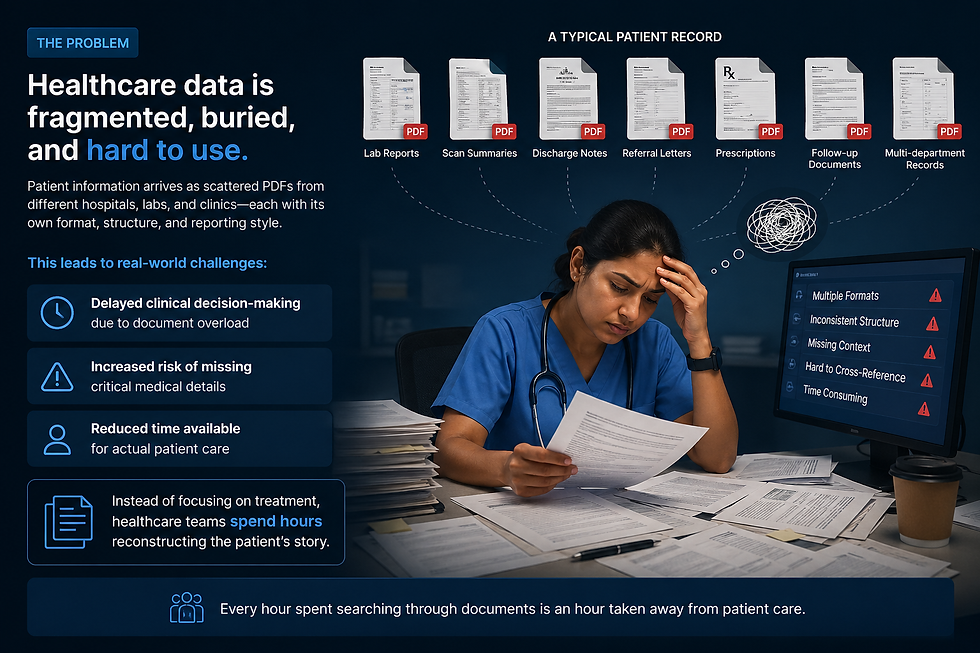
In practice, this leads to three major challenges:
Delayed clinical decision-making due to document overload
Increased risk of missing critical medical details
Reduced time available for actual patient care
Instead of focusing on treatment, healthcare teams often end up spending hours simply reconstructing the patient's story.
Solution
To solve this, we built the AI Document Parser — an intelligent document processing system designed specifically for unstructured medical data.
At a high level, the system transforms complex, multi-source PDF bundles into structured, queryable clinical intelligence. Instead of manually reading every page, healthcare teams can upload a complete patient record set once and instantly receive organized, standardized outputs.
The system extracts and structures:
Visit-level patient history
Page-level traceability and references
Key clinical entities (diagnosis, labs, medications, procedures)
Timeline-based representation of care progression
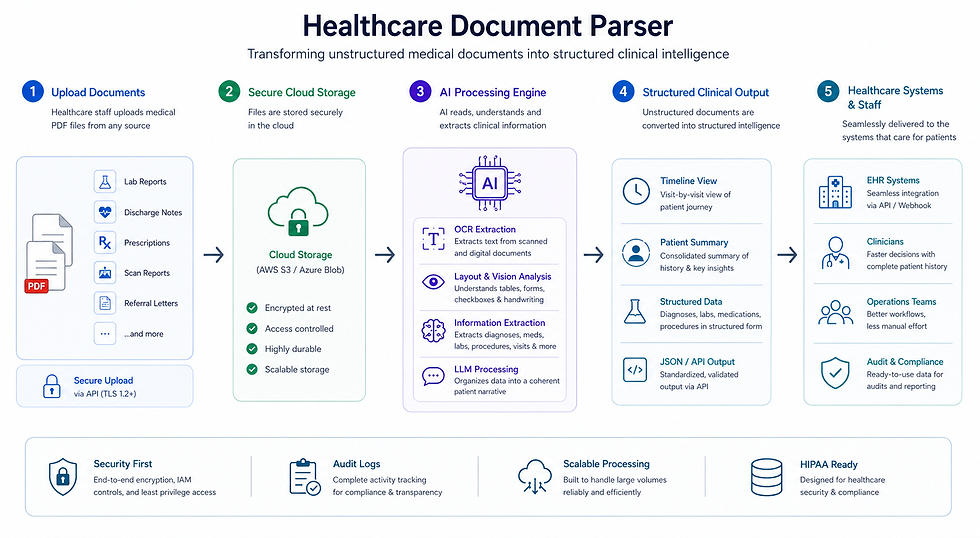
This turns scattered documentation into a unified patient narrative that is easy to navigate, verify, and act upon. The result is a coherent, structured understanding of the patient journey, designed to support faster and more accurate clinical decisions.
Impact
By transforming unstructured medical documents into structured, accessible intelligence, Holista significantly reduces the operational burden on healthcare teams. Tasks that previously required hours of manual review per patient file can now be completed in minutes, allowing clinicians and staff to focus on decision-making rather than document navigation. Patient histories become searchable, consistent, and verifiable, improving the speed and quality of clinical interpretation.
This directly leads to:
Faster clinical decision-making cycles
Reduced documentation and interpretation errors
Improved audit readiness with structured, exportable records
Higher operational throughput without linear increases in staffing
Scalable handling of growing patient data volumes

At our core, we build AI systems that turn complex, unstructured problems into clear, reliable intelligence. We focus on deep problem understanding and precise engineering to ensure every solution works in real-world conditions with accuracy and trust. Our goal is simple: create AI that reduces complexity, improves decisions, and seamlessly fits into how people actually work without compromising data privacy or system integrity.